Why commodities matter, and why portfolios hold so few
Why are commodities so central to the economy, yet so underrepresented in client portfolios?
The case begins with how the economy actually functions. Agriculture feeds populations, energy powers movement and industry, and every business — including the most technology-driven — relies on materials that originate as raw resources. Commodities are foundational rather than optional.
“You can have all the technology and AI in the world, but it won't run without commodities. They are the lifeblood of the economy.”
Steven Downey
The reason they remain underrepresented is largely structural. Unlike equities or bonds, commodities cannot easily be bought and held directly; exposure is typically gained through derivatives such as futures, which require a degree of expertise that has historically kept them within institutional hands.
“Commodities have traditionally sat in endowments and sovereign wealth funds. The individual investor has generally not had the exposure.”
Steven Downey
The diversification case
Q — What do commodities offer that equities and fixed income do not?
Their principal contribution is diversification. Because commodity returns are driven by different forces than those behind stocks and bonds, adding them to a portfolio can improve risk-adjusted returns. Critically, they tend to perform well in conditions where traditional assets struggle.
“Commodities tend to do well when the economy is expanding and inflation is rising — and rising commodity prices are themselves a large component of inflation.”
Steven Downey
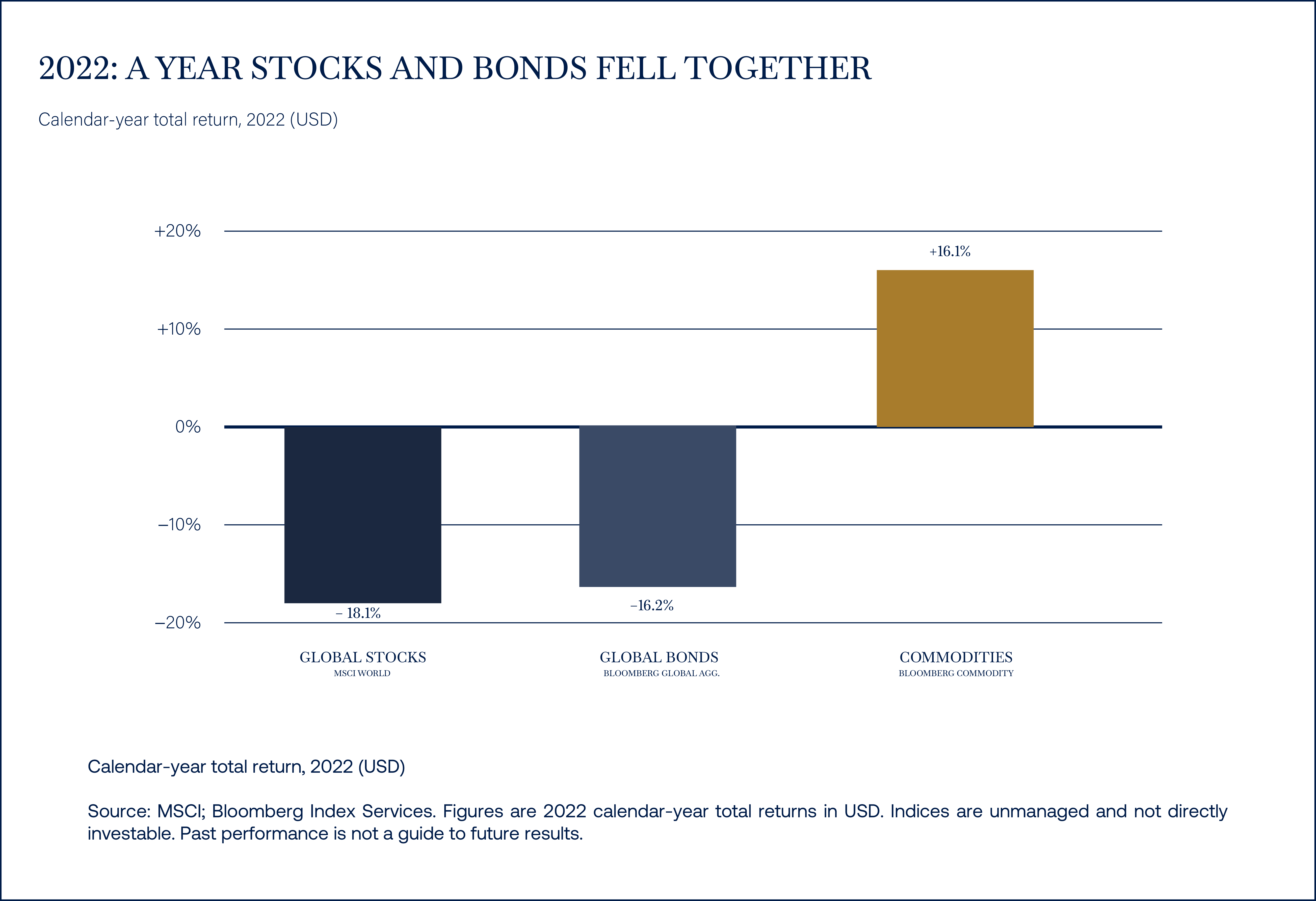
Equities and fixed income have historically come under pressure together during periods of rising inflation and interest rates. 2022 was a striking example: as inflation and interest rates rose, global stocks and bonds both fell by double digits, while a diversified basket of commodities rose. In those same conditions, commodities have often delivered positive returns — providing portfolio resilience precisely when other asset classes are weakest.
Reframing volatility as a portfolio input
Q — Commodity prices are highly volatile. How should investors think about that?
Volatility is real at the level of any single commodity, but it is the wrong unit of analysis. A diversified basket behaves very differently from its individual components.
“When you combine commodities, the volatility compresses. A basket can carry a positive expected return that no single commodity reliably provides on its own.“
Steven Downey
Because individual commodities are weakly correlated with one another, combining them reduces the volatility of the whole. Sized appropriately within a broader portfolio, even a modest commodities allocation can improve overall returns relative to the risk taken — which reframes volatility as something to be managed and harnessed rather than simply avoided.
Why the firm specialises from the Gulf
Q — Why focus on commodities from Dubai specifically?
Two factors. The first is an underserved market: relatively few financial institutions focus on research, trading support, and advisory for the commodities and natural-resources sector. The second is geographic position.
“Sitting between East and West allows us to engage with Asia in one direction and Europe and the Americas in the other. As global trade becomes more regional, that neutrality is an advantage.“
Steven Downey
A substantial share of the world's resources is produced in or shipped through the region. Combined with a commercially open, business-friendly environment, this places the firm close to the flows, counterparties, and information that inform its work.
Fund A: investing across the value chain
Q — Fund A invests in equities across the commodity value chain rather than in commodities directly. What is the rationale?
A commodity is broadly the same wherever it is produced; a company is not. Investing in well-run businesses across the chain captures the value those companies add on top of the underlying resource.
“Petroleum is broadly the same the world over. A company with proprietary technology, scale, and decades of operating experience can take that raw material and add real value on top of it.“
Steven Downey
The strategy targets businesses with durable advantages — a cornered resource, intellectual property, low-cost assets — bought at sensible valuations. It is deliberately concentrated, holding the team's highest-conviction positions rather than diluting them across a large index.
“We don't want to dilute our best ideas with our ninety-ninth best idea.“
Steven Downey
Concentration is paired with discipline on price. A high-quality company trading well above fair value is not a sound investment, and the firm prefers to wait for the right entry point rather than deploy capital simply to remain fully invested.
Risk management for commodity-exposed businesses
Q — On the advisory side, what does the firm provide to commodity-exposed businesses?
Producers, refiners, traders, and industrial users all need to manage the price risk of the commodities they depend on — across energy, metals, and agriculture — as well as the currency risk that comes with trading globally. Most, however, do not want to build the institutional infrastructure required to do so.
“Building it in-house means a trading desk, a middle office, a risk manager, and technology — significant fixed costs, far from a commodity company's core business.“
Dmitri Ganjour
The exposure is straightforward enough — a trader who buys a cargo and sells it weeks later is exposed to price movements in the interim — but the right way to hedge it is not. The choice of instrument follows from the client's exposure, not the other way around.
“Futures suit a standardised, liquid exposure where the client is comfortable with daily margining. Options come in when they want asymmetry — protection against an adverse move while keeping some of the upside.“
Dmitri Ganjour
In practice that means matching the structure to the need. A producer might buy puts to set a floor under its selling price without giving up a rally; a consumer might use a collar to cap input costs cheaply. Margin treatment matters too: futures are marked to market daily and can generate sizeable margin calls, which is manageable with strong liquidity but may point a less liquid client toward options instead. The firm provides the market access and operational infrastructure behind whichever route is right, allowing clients to manage risk without building the apparatus themselves.
Why reporting and visibility are central
Q — Why is transparency so important in managing derivatives?
Derivatives are leveraged instruments. A position that appears small in notional terms can generate significant margin requirements and cash demands at short notice. Without a clear, real-time view of positions and exposure, a client effectively loses control of the risk.
“The danger is not that the hedge is wrong — it is that the client is managing it without instruments.“
Dmitri Ganjour
The firm provides daily reporting at the account and trade level: every position, its valuation, and its margin requirement. The client understands their physical exposure better than anyone; the firm's role is to mirror it with a clean, reconciled view of the derivative book, so the two can always be aligned with confidence. This supports liquidity planning, internal governance, and accurate financial reporting.
Where investors and businesses should begin
Q — For someone assessing their commodity exposure for the first time, where should they begin?
The starting point is recognising that the exposure already exists. Even highly digital businesses depend on the metals, energy, and materials that feed their supply chains.
“Most companies have a sense of their risk. Far fewer know the most effective way to address it. That is where we add value.“
Steven Downey
The work is methodical: assess exposure commodity by commodity, quantify the effect of price movements on revenue and margins, and then decide what to hedge, what to leave open, and where to take an active view. It is detailed, unglamorous analysis — and it is precisely where considered advice makes the difference.